Garden Grove Was a Warning, San Onofre Is the Test

July 14, 2026

By Sarah Mosko

Appeared:
Fullerton Observer, 22-Jun, 2026
Times of San Diego, 30-Jun, 2026
Voice of OC, 10-Jul, 2026
Laguna Beach Independent, 10-Jul, 2026 (p. 22)
Irvine Commnity News & Views, 11-Jul, 2026
Escondido Grapevine, 14-Jul, 2026
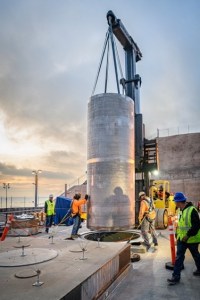
Nuclear waste storage canister (courtesy of SCE SONGS Community website)

The recent chemical plant emergency in Garden Grove should be a wake-up call for all of Southern California, home to the de facto nuclear waste dump site at San Onofre, just south of San Clemente.

In Garden Grove, the threat from a tank holding roughly 7,000 gallons of a common hazardous industrial liquid — about one-third the volume of a typical backyard swimming pool — was enough to force the evacuation of a reported 50,000 residents, close schools and roads, open emergency shelters, and mobilize a massive public-safety response.

Families had to leave their homes. Businesses were disrupted. Residents waited days for updates from public agencies and company officials, fearing the overheating and bulging tank would rupture and spill its contents or even explode.

This incident drives home an important lesson: When hazardous material is stored near homes, schools, businesses, and major roads, the danger does not have to be enormous in size to become enormous in consequence. The material stored in the tank was methyl methacrylate — a chemical used in plastic products that is also an eye, skin and mucous membrane irritant in humans. The possibility that the tank could leak its contents into adjacent neighborhoods or, worse yet, explode, was deemed enough of a public threat to trigger immediate evacuation.

Another lesson is the stark reminder that unexpected industrial accidents are a reality of our industrialized modern world, regardless of whether they result from industry failures or inadequate regulatory oversight. Simply put, dealing with dangerous substances carries inherent risks, and putting public safety first means taking as many precautionary measures as possible.

These lessons should lead us directly to San Onofre, where highly radioactive nuclear waste is stored. This nuclear waste is so deadly that it must be securely isolated away from humans and the environment for a million years. Consequently, it’s conceivable that a major leak or explosion of storage canisters at San Onofre could render Southern California uninhabitable for untold future generations.

The San Onofre Nuclear Generating Station was shut down in 2013. However, the 3.6 million pounds of highly radioactive spent nuclear fuel remain on site for the foreseeable future because there has been no progress toward creating a permanent national repository for commercial nuclear waste. Compounding the problem, efforts to persuade states such as Texas and New Mexico to store nuclear waste from other states on an interim basis have so far fallen flat.

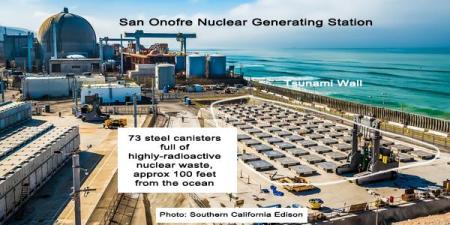
The nuclear waste storage configuration adopted at San Onofre is arguably the least safe in the nation. The spent nuclear fuel sits outside, next to the shore, in 123 thin-walled (5/8 inch) and aging steel canisters roughly 20 feet tall. The moist, salty air encourages canister corrosion.  Narrowly sandwiched between the Pacific Ocean and Interstate 5, the location is vulnerable to earthquakes, tsunamis, storm flooding, sea-level rise and terrorist attacks.

Each canister holds roughly one-third the amount of highly radioactive Cesium-137 that was released at the 2011 Fukushima nuclear disaster. This situation at San Onofre is not a distant problem. It is not merely a technical issue for federal regulators to address. It is a Southern California public-safety issue.

The comparison with Garden Grove is not perfect. A tank containing a common industrial chemical in Garden Grove and canisters storing highly radioactive nuclear waste at San Onofre pose far different threats. However, the public-safety principle at issue is the same: Dangerous materials must be stored in the safest possible configuration before a crisis occurs, not after.

At San Onofre, the question is not whether government or industry officials can reassure us that the nuclear waste is securely stored for today. The question is whether the current storage arrangement is certain to protect the public for the next several decades.

There is no guarantee that the federal government will deliver on its responsibility to provide a permanent repository for commercial nuclear waste soon enough for Southern California. That means that the stranded nuclear waste at San Onofre is not only a federal issue, it is a California public-safety problem. Local and regional leaders must not wait passively for Washington to solve it.

Southern California needs its own safety plan for San Onofre now. That plan should better secure the nuclear waste going forward, including the construction of an above-ground fortified storage facility designed for long-term monitoring, emergency protection, and resilience against flooding, earthquakes, tsunamis, fire, and security threats. It should include clear public reporting on inspections, canister integrity, emergency response planning, and options for repackaging or relocating the nuclear waste if needed.

This is not about panic. It is about our responsibility to avert a possible disaster — a disaster that could render much of Orange County and Southern California uninhabitable.

Garden Grove reminds us of the importance of taking every precautionary measure when dealing with inherently dangerous chemicals. San Onofre is our opportunity to act locally before the emergency sirens sound.
———————————–
The author thanks Irvine Mayor Larry Agran and Chief Policy Advisor Scotty Hong for their contributions and assistance in developing this article.


Home and Business Owners Alert! Property is not insured against radiological accidents at San Onofre

May 2, 2024

By Sarah Mosko

Appeared:
Voice of OC, 02-May, 2024
Fullerton Observer, 02-May, 2024
Times of San Diego, 03-May, 2024
Laguna Beach Independent, 24-May, 2024 (p. 8)
Irvine Community News & Views, 16-June, 2024

The outlined canister storage area sits next to the tsunami wall and the encroaching ocean.

Many residents of Orange and San Diego counties were relieved when the nuclear power plant at San Onofre was permanently shut down in 2013. This naïve thinking, that the plant posed risks to people and property only while the reactors were operational, was challenged in the Register’s March 31 article by lead reporter Terri Sforza in which two nuclear experts weighed in on the dangers of storing 3.6 million pounds of nuclear waste onsite at San Onofre.

The false hope in 2013 ignored the hazards of dry storage of spent nuclear fuel (SNF), containing some of the most dangerous materials on earth. Used nuclear fuel is termed “spent” only because it can no longer sustain fission in a nuclear reactor. The decay products of nuclear fission, which are what must be stored safely once a plant is shuttered, are millions of times more deadly than was the original uranium fuel.

Due to failure of the federal government to construct a geologic repository as mandated by the Nuclear Waste Policy Act of 1982, San Onofre is now a nuclear waste dump site for the foreseeable future. This waste is so highly radioactive that it requires remote handling and isolation for up to a million years. That alone is cause for concern to all southern Californians.

Storm surf is already breaching the sea wall and battering San Onofre’s tsunami wall, even before future sea level rise. Photo: Mark Mennie 1/11/24

Add to that these worrisome facts of how and where the waste is stored: adjacent to the shoreline with sea level rise inevitable; in an earthquake/flood/tsunami zone; in temporary thin-walled canisters susceptible to cracking; and in plain view therefore vulnerable to terrorist attack.

Given that in California, like most states, insurance policies for homes and commercial properties do not usually cover nuclear accidents of any type, home and business owners in southern California should be invested in ensuring that San Onofre’s SNF is being secured as safely as humanly possible.

Like most homeowners, I failed to notice the Nuclear Hazards Clause in the exclusions section of my homeowner’s policy. In mine, the exclusion applies to “any nuclear reaction, radiation, or radioactive contamination, all whether controlled or uncontrolled or however caused, or any consequences of any of these.”

This means zero insurance coverage for any radiologic-caused damage or contamination to anything within the property’s perimeter, including building structures, soil, and water. Nor are relocation costs covered if the property becomes uninhabitable.

This exclusion protects insurers from obligation to honor impossibly huge payouts when large numbers of properties are impacted.

Nuclear power plant operators are also shielded from liability and compensation to the public in the event of a radioactive release through the 1957 Price-Anderson Act. This law limits the liability of individual commercial reactor owners to a defined amount ($500 million per site). It also explicitly caps at $16.1 billion the total compensation available to the public for any radiological incident exceeding $500 million. That cap includes an industry-wide self-insurance program in which other commercial nuclear power sites chip in.

Any additional possible compensation to the public for an incident at San Onofre or elsewhere would require an act of Congress.

Contrast that $16.1 billion cap to a 2019 white paper on the economic impact of a radiological release impacting a 50-mile radius around San Onofre which concluded “. . . about $13.4 trillion in gross regional product could be at risk over a 50-year time horizon.”

The particular risks of San Onofre’s dry waste storage system were addressed in Sforza’s article. Two engineers with lifelong careers in the nuclear industry expressed differing views on the most imminent threats. Paul Blanch, a nuclear industry consultant and safety advocate, prioritizes the risks of flooding from sea level rise, storm surges, earthquakes, and tsunamis. Per Sforza, “He’d feel a lot better if the dry storage system were hoisted another 20 feet in the air.”

High surf breaching the sea wall at San Onfore. Photo: Gary Headrick 5/17/23

Regarding the views of David Lochbaum, a nuclear engineer and safety advocate turned watchdog, Sforza wrote: “Lochbaum’s concerns center on the dry storage systems themselves…. Lochbaum would feel a lot better if more regular and rigorous inspections of dry storage systems and canisters were required.”

Though these experts might disagree on the most imminent risks, there is apparent agreement that the current system for SNF storage at San Onofre is faulty, that radiological accidents are possible, and that both people and property are at risk. Many local nuclear safety advocates also want the thin-wall canisters replaced with more robust and fully inspectable thick-wall casks, as used throughout much of the rest of the world.

Despite controversy over the very best solution(s), there is widespread agreement that Southern California Edison, the Nuclear Regulatory Commission, and possibly the State of California need to take quick and decisive action to better protect people and property.

Also contained in the exclusions section of home and commercial property insurance policies is a similar War Clause. This suggest that a radiological accident at San Onofre caused by an act of terrorism could leave home and business owners doubly out of luck.


Southern California Edison Obfuscates to Hide Risks of Nuclear Energy

July 7, 2022

By Sarah Mosko

Appeared: Voice of OC, 07-Jul, 2022

One of Three Mile Island’s two nuclear reactors melted down in 1979, just three months after going online. Photo: Wikimedia Commons

According to the Merriam-Webster dictionary, to obfuscate is to be evasive, unclear or confusing. Other synonyms include cloud, muddy, fog, blur, obscure, divert, complicate, and confound.

On May 26, Voice of OC published an opinion piece from professor emeritus Roger Johnson which explains why California rightfully decided in 1976 to ban construction of new nuclear power plants and why recent calls, to both extend the operating license of Diablo Canyon, the state’s last operating nuclear plant, and to build new ones nationwide, are seriously misguided. His reasoning includes that “nuclear power is the most expensive, the most unreliable, the most dangerous, and the most environmentally unfriendly form of energy production.”

John Dobken is a spokesperson for Southern California Edison, the operator of the San Onofre Nuclear Generating Station near San Clemente which was shuttered in 2013 following radiation releases caused by steam generator failure. His rebuttal to Johnson, published in the Voice of OC on June 6, is a lesson in the art of obfuscation.

In his opening salvo, Dobken’s examples of “new supporters” for nuclear energy are a Brazilian model, an advocacy group headed by a singer-turned-nuclear-enthusiast, California voters identified in an online poll, and unnamed “various community members who value service through membership in civic groups.” The listing intentionally obscures the fact that no nuclear experts are cited. Omitted, for example, is the blockbuster joint statement issued in January by nuclear authorities from the United States, France, Germany and Great Britain detailing strong opposition to any expansion of nuclear power as a strategy to combat climate change.

Read the rest of this entry »