By Sarah Mosko
Appeared:
Voice of OC, 02-May, 2024
Fullerton Observer, 02-May, 2024
Times of San Diego, 03-May, 2024
Laguna Beach Independent, 24-May, 2024 (p. 8)
Irvine Community News & Views, 16-June, 2024
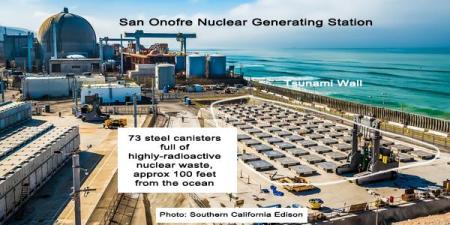
The outlined canister storage area sits next to the tsunami wall and the encroaching ocean.
Many residents of Orange and San Diego counties were relieved when the nuclear power plant at San Onofre was permanently shut down in 2013. This naïve thinking, that the plant posed risks to people and property only while the reactors were operational, was challenged in the Register’s March 31 article by lead reporter Terri Sforza in which two nuclear experts weighed in on the dangers of storing 3.6 million pounds of nuclear waste onsite at San Onofre.
The false hope in 2013 ignored the hazards of dry storage of spent nuclear fuel (SNF), containing some of the most dangerous materials on earth. Used nuclear fuel is termed “spent” only because it can no longer sustain fission in a nuclear reactor. The decay products of nuclear fission, which are what must be stored safely once a plant is shuttered, are millions of times more deadly than was the original uranium fuel.
Due to failure of the federal government to construct a geologic repository as mandated by the Nuclear Waste Policy Act of 1982, San Onofre is now a nuclear waste dump site for the foreseeable future. This waste is so highly radioactive that it requires remote handling and isolation for up to a million years. That alone is cause for concern to all southern Californians.

Storm surf is already breaching the sea wall and battering San Onofre’s tsunami wall, even before future sea level rise. Photo: Mark Mennie 1/11/24
Add to that these worrisome facts of how and where the waste is stored: adjacent to the shoreline with sea level rise inevitable; in an earthquake/flood/tsunami zone; in temporary thin-walled canisters susceptible to cracking; and in plain view therefore vulnerable to terrorist attack.
Given that in California, like most states, insurance policies for homes and commercial properties do not usually cover nuclear accidents of any type, home and business owners in southern California should be invested in ensuring that San Onofre’s SNF is being secured as safely as humanly possible.
Like most homeowners, I failed to notice the Nuclear Hazards Clause in the exclusions section of my homeowner’s policy. In mine, the exclusion applies to “any nuclear reaction, radiation, or radioactive contamination, all whether controlled or uncontrolled or however caused, or any consequences of any of these.”
This means zero insurance coverage for any radiologic-caused damage or contamination to anything within the property’s perimeter, including building structures, soil, and water. Nor are relocation costs covered if the property becomes uninhabitable.
This exclusion protects insurers from obligation to honor impossibly huge payouts when large numbers of properties are impacted.
Nuclear power plant operators are also shielded from liability and compensation to the public in the event of a radioactive release through the 1957 Price-Anderson Act. This law limits the liability of individual commercial reactor owners to a defined amount ($500 million per site). It also explicitly caps at $16.1 billion the total compensation available to the public for any radiological incident exceeding $500 million. That cap includes an industry-wide self-insurance program in which other commercial nuclear power sites chip in.
Any additional possible compensation to the public for an incident at San Onofre or elsewhere would require an act of Congress.
Contrast that $16.1 billion cap to a 2019 white paper on the economic impact of a radiological release impacting a 50-mile radius around San Onofre which concluded “. . . about $13.4 trillion in gross regional product could be at risk over a 50-year time horizon.”
The particular risks of San Onofre’s dry waste storage system were addressed in Sforza’s article. Two engineers with lifelong careers in the nuclear industry expressed differing views on the most imminent threats. Paul Blanch, a nuclear industry consultant and safety advocate, prioritizes the risks of flooding from sea level rise, storm surges, earthquakes, and tsunamis. Per Sforza, “He’d feel a lot better if the dry storage system were hoisted another 20 feet in the air.”

High surf breaching the sea wall at San Onfore. Photo: Gary Headrick 5/17/23
Regarding the views of David Lochbaum, a nuclear engineer and safety advocate turned watchdog, Sforza wrote: “Lochbaum’s concerns center on the dry storage systems themselves…. Lochbaum would feel a lot better if more regular and rigorous inspections of dry storage systems and canisters were required.”
Though these experts might disagree on the most imminent risks, there is apparent agreement that the current system for SNF storage at San Onofre is faulty, that radiological accidents are possible, and that both people and property are at risk. Many local nuclear safety advocates also want the thin-wall canisters replaced with more robust and fully inspectable thick-wall casks, as used throughout much of the rest of the world.
Despite controversy over the very best solution(s), there is widespread agreement that Southern California Edison, the Nuclear Regulatory Commission, and possibly the State of California need to take quick and decisive action to better protect people and property.
Also contained in the exclusions section of home and commercial property insurance policies is a similar War Clause. This suggest that a radiological accident at San Onofre caused by an act of terrorism could leave home and business owners doubly out of luck.


 Posted by Sarah (Steve) Mosko

 Boogie Green